

Both VoIP phone and traditional systems can support professional business calling, but do you know which is best for your business? They differ substantially in many aspects, including infrastructure, operating costs, flexibility, and outage preparation. Knowing your business service needs is especially important if you are a growing Michigan company that is moving offices, replacing aging equipment, or expanding across Southeast Michigan.
VoIP phone service providers targeting small to mid-sized businesses often emphasize features and price. However, buyers should also examine network management, cybersecurity, support responsiveness, and contract terms.
WaTech is a top pick for Michigan businesses because it combines unified communications with proactive IT support. This means tech and networking problems are often solved before they even occur. Keep reading to learn more about the differences between VoIP phone and standard business phone services.
Key Takeaways
VoIP phones send calls over the internet. This can save money compared to traditional phone lines, especially for long-distance calls and growing businesses.
VoIP offers advanced tools like voicemail-to-email, call forwarding, and mobile apps. These features make it easier for business continuity for remote work and team collaboration.
Traditional phone service uses fixed lines or PBX systems. It may be more reliable in areas with weak internet or when businesses need simple setups.
Moving to VoIP requires a strong network with good bandwidth, low jitter, and low packet loss. A trusted IT partner like WaTech helps test your setup, maintain quality of service, and manage risks during transition.
WaTech has nearly 30 years of experience helping Michigan companies move from traditional phones to VoIP. They provide support so you get high call quality and access new features securely.
The Short Answer
Hosted VoIP is the stronger choice for businesses prioritizing remote work, scalability, and modern calling features. Alternatively, traditional service remains more closely tied to office-based hardware and a physical landline. Traditional service may remain practical for a Metro Detroit location needing a simple reliable setup with little expectation of operational change.
How VoIP and Traditional Business Phone Systems Work

VoIP converts voice into digital data. It then carries it over an internet connection, commonly using Session Initiation Protocol, or SIP, to establish and manage calls. Employees can communicate through an IP desk phone, softphone, computer, or mobile app. This separates the business number from a single physical line.
Traditional business phone service relies on dedicated carrier infrastructure such as Plain Old Telephone Service, or POTS. It may also rely on Primary Rate Interface circuits, or an on-premises private branch exchange.
VoIP can connect office and remote users through a single managed platform, while traditional service usually requires physical work at each location. Access to a live helpdesk is also important because phone performance increasingly depends on the surrounding network.
What VoIP Requires
VoIP requires stable internet, compatible devices, a correctly configured router or firewall, and quality of service policies where network traffic could interfere with calls. The provider must also support number transfers, registered emergency-service addresses, security controls, and reliable technical assistance.
A managed IT partner can complete a network-readiness assessment before deployment. This allows time to identify weak wireless coverage, outdated switches, cabling problems, or firewall settings that could impair voice traffic. Unlike some National MSPs offering managed IT and VoIP services, a good Michigan provider can coordinate remote work alongside on-site corrections when necessary for a hybrid work experience.
What Traditional Service Requires
Traditional service depends on carrier circuits, physical lines, and potentially an on-site PBX that requires specialized maintenance. For AT&T customers, the October 15, 2025 POTS change deadline means that existing POTS lines can no longer be moved, added, or changed. This makes expansion and location changes more restrictive.
Legacy copper infrastructure can also become harder to support as carriers retire older services. IT security and cybersecurity firms serving regional businesses may secure the data network, however they can’t eliminate the availability and maintenance constraints of an aging telephone circuit.
What Businesses Should Compare Before Switching

A complete cost review should include implementation, handsets, headsets, cabling, network upgrades, installation, maintenance, support, taxes, and termination obligations. In 2025 U.S. pricing comparisons, VoIP averaged $15 to $40 per user per month. This is compared with $50 to $100 per traditional line per month plus long-distance fees. This displays how software-based changes can reduce the cost and delay of adding users or Michigan locations.
Businesses should also calculate the operational cost of missed calls, slow support, and poor administration. WaTech brings nearly 30 years of experience partnering with Michigan businesses with high client retention. This matters when migration planning and long-term support are considered alongside price.
Reliability, Call Quality, and Emergency Planning

VoIP quality depends on a healthy network, sufficient connection capacity, correct traffic prioritization, and active monitoring. Packet loss, latency, unstable Wi-Fi, or a misconfigured firewall can produce poor audio even when a speed test is sufficient.
Michigan weather makes continuity planning essential: Michigan recorded 157 weather-related power outage events from 2000 through 2023, the second-highest total among states. Businesses should therefore consider battery backup, redundant internet where justified, mobile failover, and automatic call forwarding.
A documented outage procedure ensures that employees know how to answer customers when office power or connectivity fails. Every organization must confirm registered service addresses and understand how its provider handles E911 at each office.
Remote and mobile users require particular attention because their physical location may differ from the address stored by the phone platform.
Features, Flexibility, and Mobility

VoIP commonly provides an auto attendant, call routing, voicemail-to-email, call forwarding, ring groups, call recording, and conference calling. These tools help a customer-facing team distribute calls consistently without requiring callers to understand the company’s internal structure.
Mobile and desktop applications allow authorized employees to make and receive calls using a business identity without exposing their personal numbers. This capability makes VoIP particularly useful for a multi-location business, hybrid team, or field workforce that cannot depend exclusively on desk hardware or analog devices.
WaTech’s Alpha Voice combines enterprise phone features with cloud-hosted administration and mobile and desktop access. The Alpha Voice smart phone app extends the business phone system to supported devices, while local, in-house expert tech support provides instant access through a live helpdesk.
When VoIP Is the Better Option
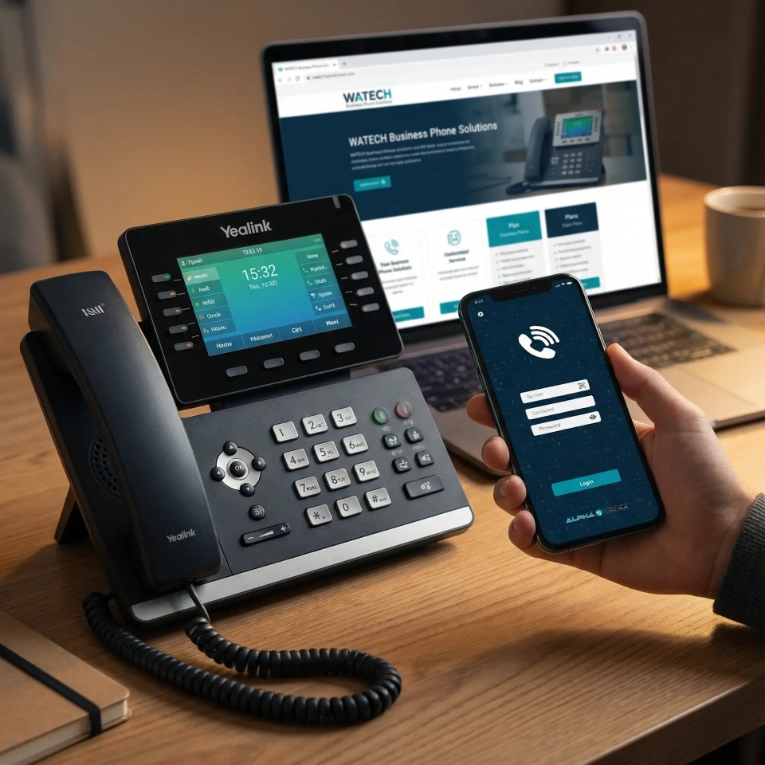
VoIP is a strong fit for growing organizations, hybrid teams, customer-service departments, and multi-site companies that need consistent call handling. 61% of small businesses use VoIP daily, reflecting its relevance for flexible communication and centralized administration.
A traditional or hybrid phone system service may be a better fit when a business has critical analog equipment or a phased migration requirement. Coexistence can serve as a controlled transition strategy rather than forcing every number, device, and workflow to change simultaneously.
Choose VoIP If Your Business Needs:
Fast user additions, removals, and role changes
Shared call queues and centralized administration
Remote answering through mobile or desktop devices
Consistent features across multiple locations
Call continuity options during a site outage
Growth without repeated on-site PBX installations
Consider Traditional or Hybrid Service If You Have:
Critical legacy devices that cannot yet migrate safely
Unreliable internet without a practical backup option
Regulatory or operational requirements linked to analog service
A phased plan for moving numbers, equipment, and workflows
Specialized systems that require verified line compatibility
When Traditional Phone Service is the Better Option

Traditional service is best for a location that requires only simple calling needs and limited internet reliability. A low-volume site without remote employees, advanced routing, or expansion plans may receive little immediate benefit from replacing a stable system.
Some organizations also prefer to delay migration because they are not ready to retrain employees or move phone administration into the cloud. That preference carries a long-term tradeoff because carrier dependency, hardware maintenance, and limited remote functionality can restrict future choices.
How WaTech Helps Michigan Businesses Move to VoIP With Less Risk

WaTech manages phone systems and their supporting technology as one coordinated service. This approach reduces the divided responsibility that can occur when separate vendors manage internet connectivity, networking, phones, security, and cabling.
WaTech provides comprehensive IT services including managed IT, VoIP phone service, structured cabling, and white label IT solutions. Its migration process can cover discovery, network assessment, feature planning, number porting, device setup, training, testing, and post-launch assistance.
Alpha Voice offers cloud-hosted flexibility, enterprise calling functions, and mobile and desktop access. Proactive monitoring and direct live-helpdesk access distinguish WaTech from local Michigan managed IT service providers.
WaTech uses fair, usage-based billing designed to avoid unnecessary extras and uncontrolled cost growth. Actual pricing depends on the required users, devices, calling patterns, infrastructure, and implementation work.
VoIP phone service is ideal for growing Auburn Hills businesses that want reliable business phone service with local coordination. On-site support is useful when structured cabling, desk phones, network corrections, or multiple offices must be managed together.
Choose a Business Phone System That Can Grow With You
The right option for your business will depend on your current infrastructure, tolerance for outages, legacy-device requirements, workflows, and locations. IT consulting firms specializing in network infrastructure may evaluate connectivity, but WaTech can also coordinate the network, cybersecurity, devices, cabling, phone platform, and ongoing support within the same service.
Contact our team at WaTech for your tailored VoIP migration plan, and to learn more about building a business phone system that supports your next stage of growth.
FAQs
VoIP depends on reliable internet, electrical power, and the right network configuration. Poor connectivity or inadequate backup planning can disrupt calls, so businesses should assess the network and establish tested failover procedures.
VoIP sends calls through an internet connection and can operate across desk phones, computers, softphones, and mobile devices. Standard phone service typically uses dedicated physical lines and remains more closely tied to installed equipment.
The limitations of any specific provider, including VoIPfone, depend on its plans, included features, support model, network requirements, and emergency-calling configuration. Compare those details with your continuity requirements and preferred level of technical support before signing a contract.
VoIP is worthwhile for many small businesses because it supports remote access, modern routing, easier administration, and gradual growth. Small-business VoIP deployments can support calling from laptops, smartphones, and tablets and allow users to be added or removed through a web portal.